



Description
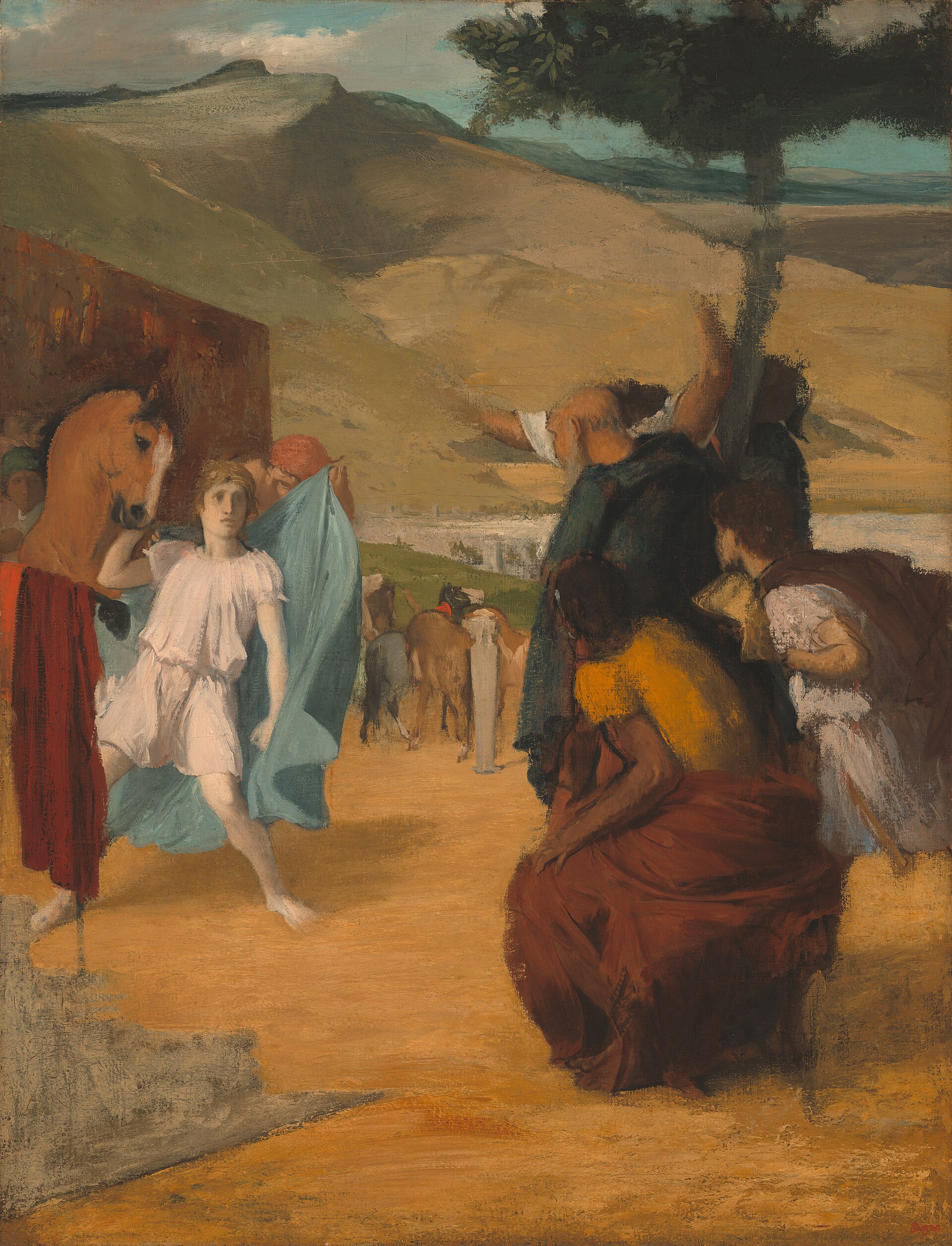
Alexander and Bucephalus is a large early Degas, and almost nothing about it looks like the Degas most people know. Across a wide sandy path a young man strides in a short white tunic, barefoot, his body pressed forward; behind him a pale blue-green cloak lifts in an arc, held up by a figure in a red cap. At the left a light bay horse with a white blaze lowers its head towards the boy. At the right a group of onlookers sits and stands, seen from behind, and above them an umbrella pine rises on a slender trunk. In the distance round hills follow one another, a band of water and a pale line of walls, and along the path a file of horses and riders moves away. The original is 89 x 115 cm, painted in 1861/1862, and it hangs in the National Gallery of Art in Washington under accession number 1997.57.1. The mark at the lower right is not a signature but the stamp of the 1918 studio sale. We make it by hand, in eight sizes from 30 x 35 to 100 x 110 cm or to your own measurement, and before dispatch you receive a photograph of the finished work for approval.
| Title: | Alexander and Bucephalus |
| Other titles: | Alexandre et Bucéphale (the catalogue’s title), Achille et le Bucéphale (the title of the 1918 studio sale) |
| Painter: | Edgar Degas (1834–1917) |
| Year: | 1861/1862 (studio-sale stamp at the lower right, not a signature) |
| Size of the original: | 89 cm x 115 cm |
| Technique of the original: | oil on canvas |
| Painting style: | impressionism |
| Where the original hangs: | National Gallery of Art, Washington (accession 1997.57.1), bequest of Lore Heinemann in memory of her husband, Dr. Rudolf J. Heinemann; catalogue Schulman MS 1532, Lemoisne I-91 |
| Our version: | hand-painted oil on linen, 8 sizes from 30 x 35 cm to 100 x 110 cm, custom size on request |
Alexander and Bucephalus – Edgar Degas
Who is in the scene?
A boy and a horse: Alexander, still a child, taming the stallion Bucephalus that nobody else could ride. He strides across a wide sandy path in a short white tunic, barefoot, his body pressed forward. Behind him a pale blue-green cloak lifts in an arc, held up by a figure in a red cap. At the left the horse — a light bay with a white blaze — lowers its head towards him, and that lowering is the whole point of the picture: the animal has already given in. At the right a group of onlookers sits and stands, seen from behind: one figure in a dark blue-green cloak with an arm raised, a seated woman in a deep red-brown robe with a yellow sleeve, and two shrouded figures beside her.
What is behind them?
A landscape that has nothing to do with Macedonia and everything to do with Italy. Above the onlookers an umbrella pine rises on a slender trunk with a dark crown — the tree of the Roman campagna, not of the Balkans. In the distance round hills follow one another, a band of water and a pale line of walls; along the path a file of horses and riders moves away, a narrow light column among them. The whole rests on ochre and sand, against which the blue-green sky, the dark foliage and the red accents do all the work. Degas had come back from three years in Italy not long before, and the scenery he gave an ancient Greek story is what he had just been looking at.
Why does this painting look so unlike Degas?
Because it is what he was trying to be before he became what he is. In the early 1860s Degas wanted to be a history painter in the grand French tradition: big canvases, subjects from antiquity, figures across a shallow stage. This is one of those attempts, nearly a metre and a fifth tall. Within a few years he abandoned the programme and turned to laundresses, dancers and the racecourse — and the horse here is the thread that survived. The onlookers seen from behind, the figure cut by the edge, the action pushed to one side: those are already the habits of the later Degas, hidden inside a subject he would soon give up.
What does the scene mean?
That mastery is a quiet moment, not a struggle. There is no rearing, no drama, no rope; the horse simply lowers its head. As a canvas painting it therefore reads calmly despite its size, and because the palette is ochre, sand and blue-green it makes warm rather than loud wall art — for a study, a stairwell or a long wall in a living room. Among Degas’s works it is the odd one out, and that is why some people want it: it shows him before he was himself. Our reproduction is built around the two things that carry the scene, the lowered head of the horse and the arc of the cloak.
From the studio sale to Washington
Degas never sold this painting, and its history begins the year after his death. It went into the first Degas studio sale, at the Galerie Georges Petit in Paris on 6-8 May 1918, as lot 5 — and the catalogue named it Achille et le Bucéphale, Achilles, the wrong hero altogether. By 1951 it belonged to Dr Hans Graber (1886-1956) of Morcote, an art historian who wrote on Degas; the museum notes that it was lent that year to an exhibition in Bern from a private collection in Morcote, identified as Graber’s by Douglas Cooper in 1953. It then passed through Walter Hugelshofer in Zurich, and from October 1956 was held by M. Knoedler and Co. in New York on joint account with Pinakos, Inc., the company of Rudolf Heinemann. His widow Lore Heinemann bequeathed it to the National Gallery of Art in 1997, in his memory, and that bequest is still the museum’s credit line.
The motif among Degas’s works
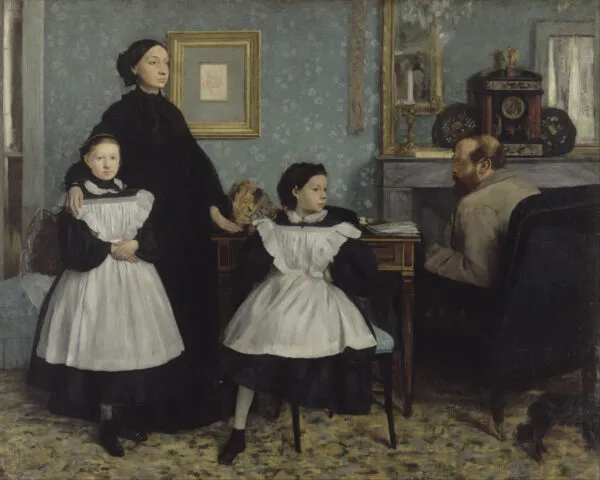
This canvas sits between two things we also sell. View of Rome from the Banks of the Tiber is the Italy that gave this picture its hills and its pine, painted a few years earlier, and The Bellelli Family is the other large early composition from the same ambition. The horse leads the other way: the National Gallery of Art showed this very painting in its 1998 exhibition Degas at the Races as catalogue number 6, which places it at the head of a line that runs to Racehorses at Longchamp. The original is in the National Gallery of Art, Washington, which records it as Alexander and Bucephalus, 1861/1862, oil painted on canvas, overall 115 x 89 cm, accession 1997.57.1, and the Schulman catalogue lists it as MS 1532, Lemoisne I-91, with the Vente Degas stamp at the lower right.
How is our hand-painted version made?
With a brush and oil paint, in the same technique as the original, as an oil on canvas. The hardest part is the horse’s head. Everything the picture says is in that one downward movement, and it must be drawn before it is coloured; a centimetre too high and the animal looks curious rather than yielding. The second is the cloak, whose arc holds the top third together — it must stay a single sweep, not a folded cloth. The third is the ground: ochre and sand across the whole width, which sounds easy and is not, because a flat ochre kills the picture and a busy one takes it over. No two versions are quite alike; each hand-painted copy is its own. For this motif we have no photographs of our finished canvases yet, because we have not painted it before, so none are shown here and none are described. A photograph of your own canvas comes to you before dispatch.
Which size for which wall?
Here we have to be straight with you: none of our eight sizes has the proportion of the original. The original is 89 cm wide and 115 cm high, a ratio of 1.29. The eight sizes run from 30 x 35 to 100 x 110 cm, and their ratios run from 1.09 to 1.17 — every one of them squarer than the painting. In practice the scene is compressed in height at every size, with less sky and less pine above the heads. Closest in shape are 30 x 35 and 60 x 70 cm, at 1.17. Closest in scale is 100 x 110 cm, a genuinely large painting at that size, and 90 x 100 cm matches the original’s width almost exactly, to a single centimetre, but is 15 cm short. If the proportion matters to you — and on this composition it does — the honest answer is a custom size at 89 x 115 cm. Of the eight, 90 x 100 cm is the one we would suggest. None is held in stock: every piece is made to order.
Custom size, frame and stretcher
Because no rung of the ladder fits this work, a custom size is genuinely the better product here rather than an upsell: we paint at 89 x 115 cm, or at any size holding the ratio of 1.29, so the pine and the sky above the figures stay where Degas put them. That is our work made to order. Every piece ships stretched on a wooden stretcher, ready to hang. For the frame use our 3D application: it shows every moulding we carry — gold, silver, black, white and natural wood — and serves the choice of frame and nothing else. How it behaves on your own wall is shown by our separate service, placement in the room.
Delivery and guarantee
Every piece is made to order in our workshop in Slovenia; allow 15-45 days depending on the size, at the largest sizes usually at the upper end. It travels stretched and protected for transport, framed if you chose a frame, to sixteen countries in the European Union, without customs. Before dispatch you receive a photograph of the finished work for approval, and our returns arrangement applies to every order. The whole range is in the Edgar Degas gallery, and his life is described in our article on Edgar Degas.
Frequently asked questions
What work is this?
An early history painting by Degas, recorded by the National Gallery of Art in Washington as Alexander and Bucephalus, 1861/1862. It measures 89 x 115 cm, accession 1997.57.1.
Is the painting signed?
No. The mark at the lower right is the stamp of the Vente Degas — the studio sale held after his death — not a signature. The catalogue records it as a stamp, and we say so.
When was it painted?
1861/1862, the museum’s own dating. The Schulman catalogue gives 1860-1861; where the two differ we follow the institution that owns the picture, and name the other figure here rather than hide it.
Why was it sold as Achille et le Bucéphale?
Because that is how the 1918 studio-sale catalogue listed it, under Achilles rather than Alexander. The museum records the title, and it is why you still meet the picture under two heroes’ names.
Is that really an Italian landscape?
The umbrella pine, the round hills and the pale walls are the scenery of the Roman campagna, and Degas had returned from three years in Italy shortly before. The museum record does not comment on it; that reading is ours.
Who was Lore Heinemann?
The widow of Dr Rudolf J. Heinemann. She left the painting to the National Gallery of Art in 1997 in his memory, and the museum’s credit line still reads that way.
How big is the original?
89 cm wide and 115 cm high. With its frame the museum gives 107.95 x 139.7 cm, so a framed version at full size needs a good deal more wall than the canvas figure suggests.
Which of your sizes matches the original?
None of them, and we would rather say so than let you find out. All eight are squarer than the painting. For the true proportion, ask for a custom size at 89 x 115 cm.
Which size do you suggest if I want a standard one?
90 x 100 cm. It matches the original’s width to within a centimetre, though it is 15 cm short in height, so the scene sits slightly tighter under the top edge.
Is this a print?
No. The work is made by hand in oil on linen; the brushstrokes are visible and can be felt, on this motif most of all in the horse’s coat and the sandy ground.
Is it suitable as a gift?
Yes, and an unusual one — a Degas that does not look like a Degas, with a boy, a horse and a story attached. Since every piece is made to order, allow for the making time; if you would rather leave the choice to the recipient, there is our gift voucher.
- Motif: the boy Alexander taming Bucephalus, the horse already lowering its head, in an Italian landscape
- Original: Edgar Degas, 1861/1862, oil painting, 89 x 115 cm, National Gallery of Art, Washington (1997.57.1)
- Our version: hand-painted in oil, eight sizes from 30 x 35 to 100 x 110 cm; none matches the original’s proportion, so a custom size is the better choice
- Worth knowing: the mark at the lower right is the 1918 studio-sale stamp, and that sale listed the picture under the wrong hero, as Achille et le Bucéphale