



Description
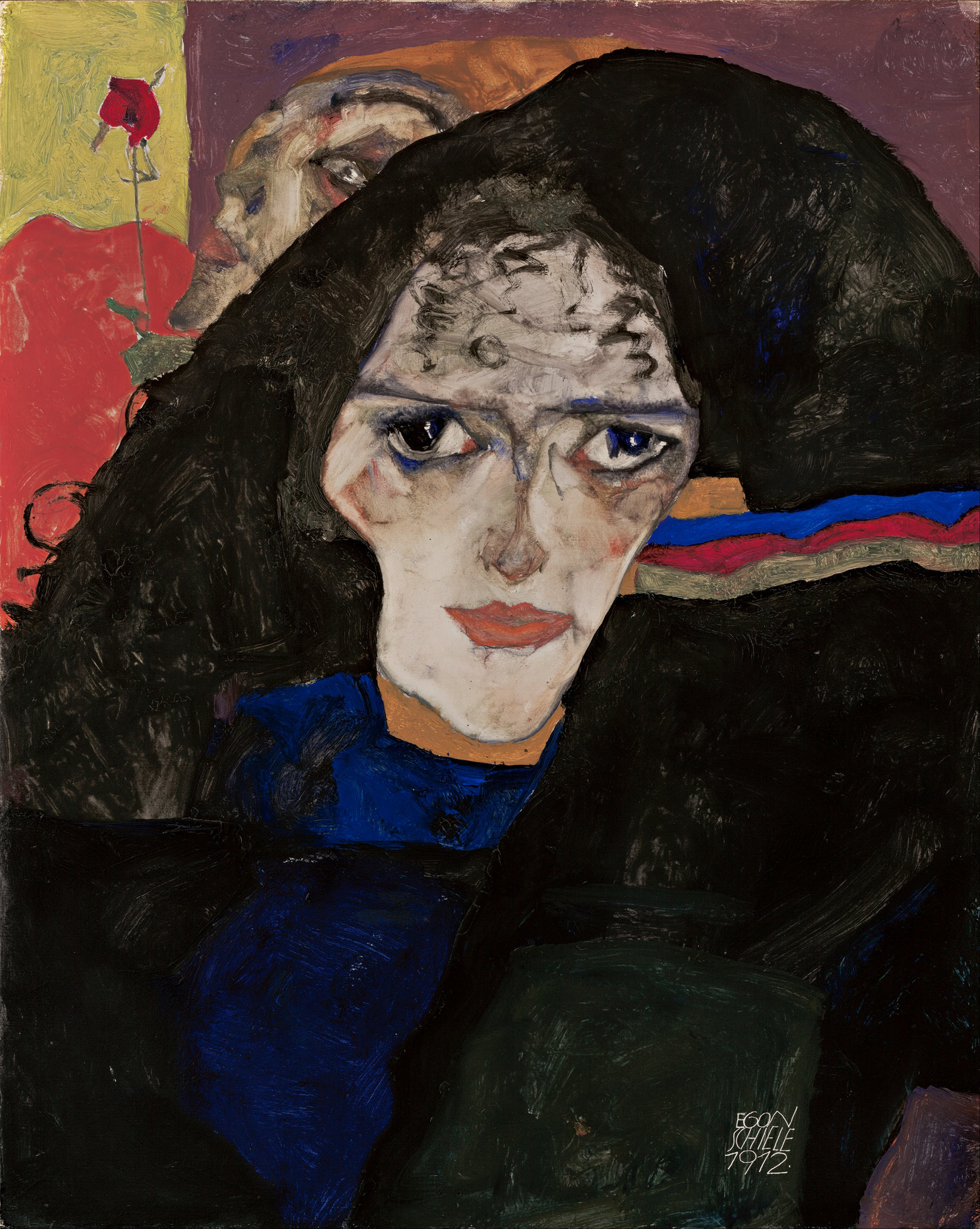
Mourning Woman is a work of 1912 by Egon Schiele: a pale face with large dark eyes, wrapped in a heavy black cloth, and behind it at the upper left a second head in three-quarter profile beside a single red rose. The original is in the Leopold Museum in Vienna under inventory number 461; it measures 34 x 42.5 cm — 34 cm wide and 42.5 cm tall, a small upright panel. We make it as a hand-painted oil painting on canvas, in thirteen sizes or to your own measurement, and we send you a photograph of the finished work for approval before it ships.
| Title: | Mourning Woman |
| Other titles: | Trauernde · Žalujoča |
| Painter: | Egon Schiele (1890–1918) |
| Year: | 1912; signed and dated lower right “EGON SCHIELE 1912” |
| Original size (width × height): | 34 cm x 42.5 cm |
| Original technique: | Oil on wood |
| Style: | Expressionism |
| Location: | Leopold Museum, Vienna (inv. 461) |
| Our reproduction: | hand-painted oil on canvas, 13 sizes from 50 x 65 cm to 160 x 205 cm, or a made-to-measure size |
Mourning Woman – Egon Schiele
What does the work show?
A face that looks straight back. In the middle of the panel is a pale, almost white face with large dark eyes rimmed in blue, a thin nose and red lips; dark curls fall over the forehead, and the whole head is wrapped in a heavy black cloth that fills most of the panel. Below the chin a band of ochre and a blue garment show. Behind, at the upper left, a second head leans out in three-quarter profile, greyish, with a pursed mouth and a raised brow. The ground there is yellow-green above and orange-red below, and a single red rose stands on a thin stem. To the right of the face, a band of blue, red and grey stripes breaks through the black. Lower right, in three short lines, is the signature.
Who is the mourning woman?
The title does not say, and it is not Schiele’s: per the museum record, it was not chosen by the artist himself. The record describes a figure gazing out of the painting with a melancholy yet combative expression; its head is shrouded in a dark cloth, and the contours together with the pale complexion almost evoke the impression of a skull. That is the reading of the museum that holds the work, and we give it as theirs.
Whose is the second head?
Both Schiele’s and not. Per the record, the second figure’s colouring nearly blends with the reddish shades of the background, and its physiognomy — the pursed mouth, the raised eyebrows — is characteristic of Schiele’s renderings of his own face. But the red hair added to it is, the museum writes, a trademark of his then partner Wally Neuzil (1894–1917): attributes become interchangeable and the lines blur. The museum reads this as part of a wider theme in his portraits and self-portraits — identity as something unstable, and the search for one’s own self in others.
What is the rose?
The record lists the rose among the work’s keywords but does not interpret it, and we will not invent a meaning for it. On the panel it is small and bright: a red bloom on a thin stem against the yellow-green and orange of the upper left corner, next to the second head.
What is the original painted on?
On wood. Per the record the technique is oil on a wooden panel, signed and dated lower right. Our reproduction is painted in oils on canvas. We do not present those as the same thing: a small wooden panel and a stretched canvas are different supports, and we name the difference.
Is the format upright or horizontal?
Upright. Our steps follow it in a portrait format, from 50 x 65 cm to 160 x 205 cm. The height lets the black cloth fall from the top of the head to the lower edge.
Can I have it at the size of the original?
At the size of the original, no: the panel is 34 x 42.5 cm, and our smallest step, 50 x 65 cm, is larger on both sides. In proportion, three steps are exact: the original’s ratio of sides is 1 : 1.25, and 60 x 75 cm, 80 x 100 cm and 120 x 150 cm have precisely that ratio; 65 x 81 cm is two and a half millimetres short. The other nine are cut taller, by 2.5 cm or 5 cm. If the proportion matters, choose one of the three exact steps; for the original’s size, a made-to-measure size.
Where does the work come from and where is it now?
This page carried no provenance note before — for this work there was none, which we say openly rather than quietly supplying a substitute. What follows is the chain as the museum publishes it: Heinrich Benesch, Vienna, from before 1925 to 1947; Otto Benesch, Vienna, 1947–1964; Eva Benesch, Vienna, 1964–1983; Jenö Eisenberger, Vienna, 1983; Rudolf Leopold, Vienna, 1983–1994; and from 1994 the Leopold Museum Private Foundation. The reading of it is ours. The chain has no gaps, but the first date is only “before 1925”. It is station for station the chain of Calvary in the same collection, and for the last private step the museum cites the same documents for both: a receipt of 30 September 1983 and a confirmation from the art dealers Giese & Schweiger of 19 February 2002. A dossier by Sonja Niederacher of 30 April 2011 is also listed. The work is today in the Leopold Museum under inventory number 461; the museum’s whole Schiele holding is on the Leopold Museum’s Egon Schiele page.
Where does this work sit among Schiele’s works?
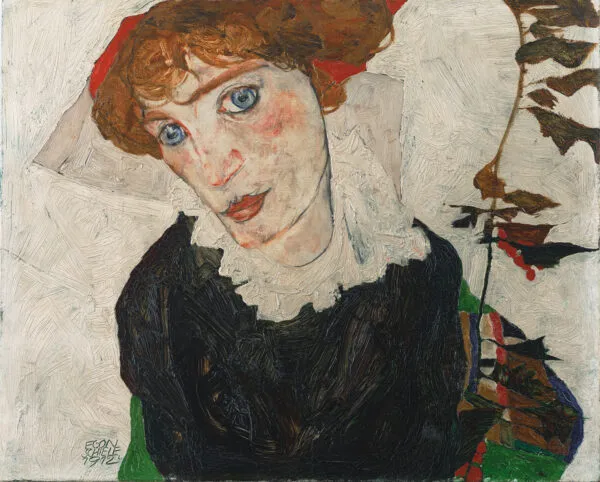
Among the portraits and self-portraits of 1912. From the same year are the Portrait of Wally Neuzil — the portrait of the partner whose red hair the museum sees in the second head — and the Self-Portrait with Physalis, which the museum describes as the counterpart to that portrait; both are small panels too. The full selection is in the Egon Schiele gallery, with more on his life in our article about Egon Schiele. Schiele was a younger contemporary of Gustav Klimt and the Vienna Secession was the milieu he came out of; Viennese Expressionism is the movement he helped define, and Austrian art of the period is still read through those two names. As an expressionist painting it lets two identities share one small panel. Setting Sun, from the year after, is oil on canvas; this panel is not.
How is our hand-painted version made?
Every canvas is painted by an artist in oils, stroke by stroke — not a machine impression but a hand-painted copy made for your order. Two places are the hardest here. The first is the eyes: large, dark, rimmed in blue, and set so that they meet the viewer directly; move a pupil by a millimetre and the combative look the museum describes turns vague. The second is the second head, whose colours almost blend into the background — it must stay half-lost, legible but never as strong as the front face, or the painting becomes a double portrait of two separate people. When the work is finished we photograph it and send you the photograph for approval, and only then does it ship. For this family we hold no studio photographs — it has not been photographed in our workshop yet, and nothing has been removed; when it is next painted it will be photographed and the images added here. As a canvas reproduction it arrives stretched on a wooden bar, ready to hang.
Which size suits which wall?
Short answer: a face this direct works close to eye level. For a narrow wall, a study or beside a doorway 50 x 65 cm or 60 x 75 cm; above a sideboard 80 x 100 cm; for a large room 120 x 150 cm and up to 160 x 205 cm. Our smallest size is 50 x 65 cm. A canvas painting of a single face grows more confronting with size: at the smaller steps it keeps the intimacy of the panel, at the larger ones the gaze reaches across the room.
How do I order a made-to-measure size, stretcher bar and frame?
If none of the thirteen sizes suits your wall, we paint the work to your own measurement. The canvas comes stretched on a wooden bar; our 3D application is for choosing a frame only, not for showing the work on your wall. The frame is chosen separately and need not be part of the order.
How is it delivered and what do we guarantee?
We paint to order and deliver to sixteen countries in the European Union, among them Germany, France, Italy, the Netherlands and Poland; the United Kingdom and Ireland are not currently among them. Before dispatch we send you a photograph of the finished work for approval, and if you are not satisfied we correct the work or paint it again. Production time varies with the size and the studio’s workload.
Frequently asked questions
Is the Mourning Woman a real person?
She is not named, and the title is not Schiele’s own: according to the Leopold Museum, it was not chosen by the artist. The museum describes a figure gazing out with a melancholy yet combative expression, her head shrouded in a dark cloth, the contours and the pale complexion almost evoking a skull.
Who is the second head in Mourning Woman?
The museum sees Schiele himself in it: the pursed mouth and the raised eyebrows are typical of the way he rendered his own face. The red hair, however, is a trademark of his partner at the time, Wally Neuzil, so the two identities blur. The museum reads this as part of his search for his own self in others.
When did Schiele paint Mourning Woman?
In 1912; the panel is signed and dated lower right “EGON SCHIELE 1912”. It is painted in oils on wood and measures 34 x 42.5 cm, a small upright format. From the same year come the Portrait of Wally Neuzil and the Self-Portrait with Physalis, both small panels as well.
Who owned Mourning Woman before the Leopold Museum?
The museum’s record begins with Heinrich Benesch, Vienna (before 1925 to 1947), then Otto Benesch (1947–1964) and Eva Benesch (1964–1983), followed by Jenö Eisenberger and Rudolf Leopold in 1983. Heinrich Benesch, a railway official, was one of Schiele’s earliest collectors and friends; his son Otto became an art historian and later director of the Albertina, and Eva was Otto’s wife.
Where is Mourning Woman today?
In the Leopold Museum in Vienna, under inventory number 461. Since 1994 it has belonged to the Leopold Museum Private Foundation, and the museum holds one of the largest Schiele collections in the world.
Does it work as a gift?
It does; if you are unsure which size to choose there is a gift voucher.
- Subject: a pale face in a black cloth, a second head behind it and a single red rose.
- Original: 1912, oil on wood, 34 x 42.5 cm, signed lower right, Leopold Museum, Vienna, inv. 461.
- Ours: hand-painted in oils on canvas, 13 sizes or a made-to-measure size.
- Worth knowing: the title was not chosen by Schiele, per the museum.