


Description
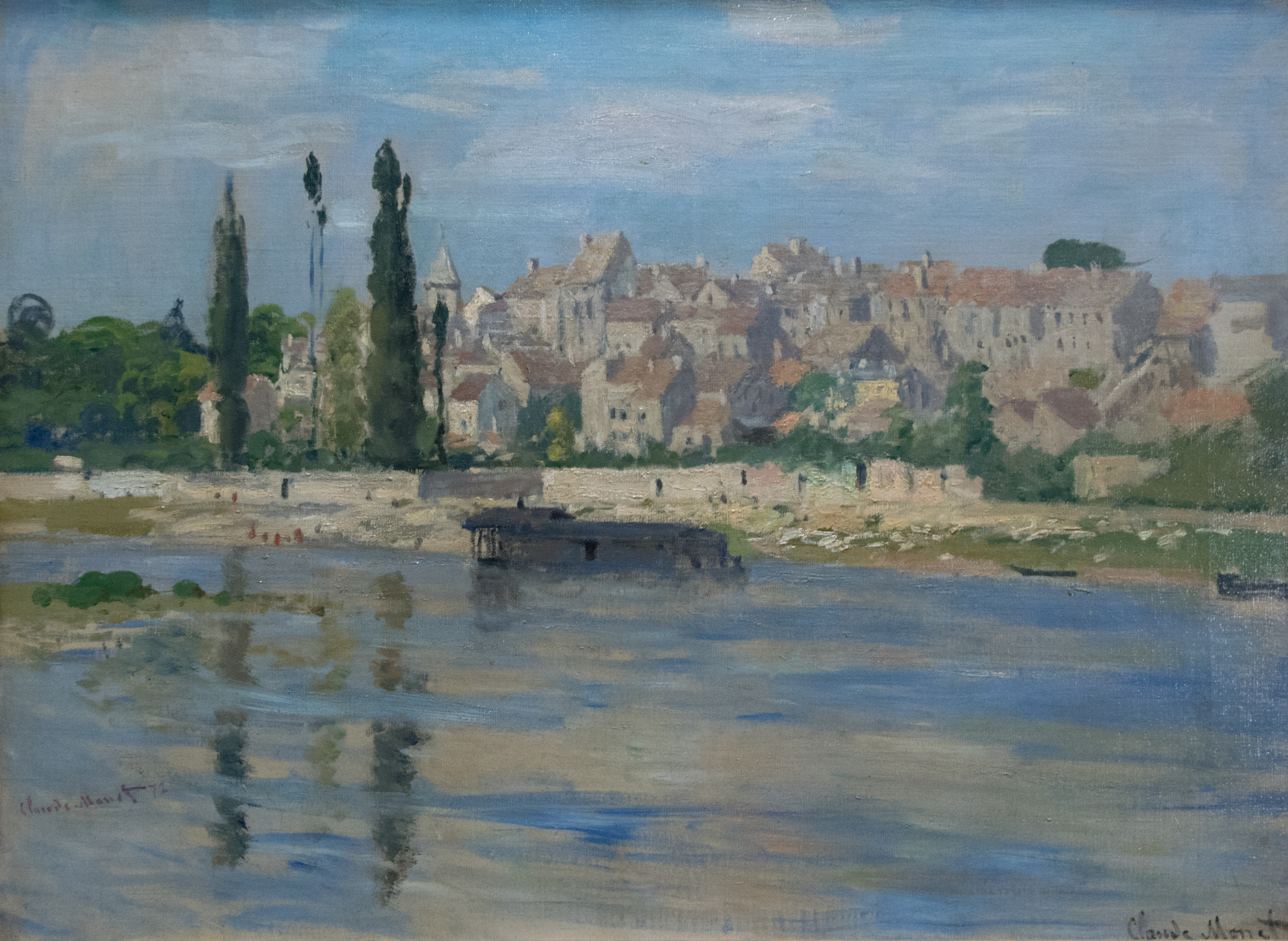
Carrières-Saint-Denis is a hand-painted reproduction of Monet’s canvas at the Musée d’Orsay: from the far bank we look straight across a wide river at a village of pale houses climbing the slope, with a long stone quay in front of it and a dark barge moored alongside. The original measures 81 x 61 cm, is oil on canvas and carries the accession number RF 1674. The museum dates it to 1872, and the canvas carries a signature in both lower corners. We paint it in eight sizes or to your own, with a photograph of the finished work for approval before despatch.
| Title: | Carrières-Saint-Denis |
| Other titles: | Carrières-Saint-Denis ; Vétheuil (the full designation in the Musée d’Orsay record) · Wildenstein catalogue, no. 237 |
| Painter: | Claude Monet (1840–1926) |
| Year painted: | 1872 in the museum record, without a hedge; the museum transcribes no inscription, and we read the signature at the lower left as “Claude Monet 72” |
| Original size: | 81 cm x 61 cm |
| Original technique: | Oil on canvas |
| Painting style: | Impressionism |
| Located at: | Musée d’Orsay, Paris (acc. no. RF 1674) |
| Our reproduction: | Hand-painted oil on canvas, eight sizes or made to measure |
Carrières-Saint-Denis – Claude Monet
What do we see from the far bank?
The viewpoint stands low by the water and looks straight across the river. On the opposite bank a village rises: pale houses with red-brown roofs crowd together and step up the slope, and left of centre a tower with a pointed roof stands clear of them. Below the houses runs a long low stone quay, pale and almost horizontal, which holds the upper half of the canvas in balance.
Moored against it at the centre is a large dark barge with a flat roof, the only truly dark area on the canvas. To its left is a sandy shallow where a few small figures stand, given as red and orange dots. At the right edge lies a second small boat.
What is on the canvas?
Three tall dark poplars stand left of centre and reach almost to the top edge; it is they that give the canvas its uprights. The sky is blue with drawn-out white cloud. The lower third is water, painted in long horizontal strokes, and in it the poplars and the barge run downwards as long smeared reflections.
First: it is not the houses that are mirrored in the water but the poplars and the barge, the houses at most as pale patches of colour. Second: it is not true that the trees are not yet in full leaf; the poplars are dense and dark. We have also withdrawn the judgement that painting of this kind was unheard of at the time, because no museum record supports it.
Two signatures on one canvas, and what the museum says about them
At the lower left, in dark red strokes, stands “Claude Monet 72”, with a year that agrees with the museum’s. At the lower right stands a second signature, in dark blue, with no year, running to the very edge of the canvas.
The museum says nothing about either. The record for RF 1674 has no field for an inscription, so there is neither confirmation nor denial. The reading is therefore ours, from our own photograph, and we give it as that. The distinction matters: for some other canvases in this collection the museum transcribes the signature itself, and here it does not.
What does the museum record say about the size and the year?
The work is held by the Musée d’Orsay under accession number RF 1674. It publishes the measurements height by width, 61 x 81 cm; our table puts the width first, so here you read 81 x 61 cm.
The year is 1872, with no range and no cautious about. We say so out loud, because a page that says it and a page on which nobody compared look the same.
How did the work reach the Orsay?
By a single line, and that is the thing worth saying. The museum gives the mode of acquisition — the donation of Étienne Moreau-Nelaton in 1906 — and nothing else. There is no chain of owners of the kind other museums publish for some canvases, so we are not going to assemble one out of guesses.
What is known is therefore this: the canvas entered the French national collection as a gift in 1906. Who held it before, and by what route, does not appear in the museum’s record.
Why does the work carry two names in the museum?
Because the Musée d’Orsay writes both into the designation, separated by a semicolon: Carrières-Saint-Denis ; Vétheuil. At first sight that looks like doubt about the place, since the two places are far apart.
We checked whether it is doubt or a form of record, and the answer is the form. The same collection carries Coquelicots ; La promenade for RF 1676 and Effet de neige à Vétheuil ; L’Église de Vétheuil, neige for RF 3755. Three of the three Monet records we opened carry a second designation after the semicolon, so this is how the Orsay writes, not a warning. Our title follows the first name; the full designation stands in the table.
Which Monet canvases of the same river do we sell?
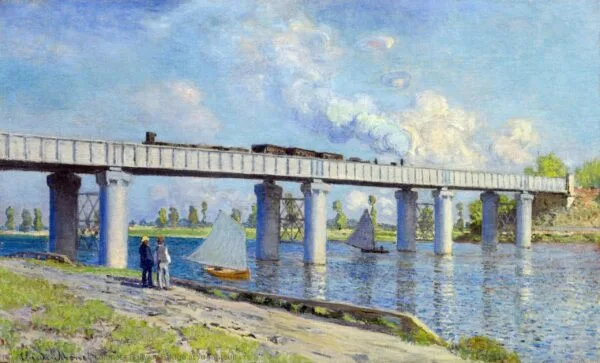
This one has an unusual neighbour among them. The Argenteuil Basin is from the same year, is held by the same museum and measures 81 x 60 cm — exactly as wide and a single centimetre lower. Two canvases that close in size behave like a pair on one wall.
In our Claude Monet gallery the work stands beside several views of that river: Bridge at Argenteuil shows the same bank two years later, and The Seine at Bougival shows it a few years earlier. The second name in the museum’s designation belongs to Snow Effect in Vétheuil and Banks of the Seine, Vétheuil; the first of those is held by the Musée d’Orsay too, under RF 3755.
How is our hand-painted version made?
Every order is painted individually by an artist, in oils on cotton or linen canvas. That is how every canvas painting is made here: no print, no transfer, no machine step. This impressionist painting is demanding in its reflections. The poplars are not repeated in the water but dissolved, and if the hand draws them too definitely the river becomes a mirror instead of water. The second test is the village: dozens of small houses in three or four pale tones, which have to stay separate without turning into a pattern. Out of doors, en plein air, the underlayer stays light and shadow is built from cool glazes.
Which size for which wall?
Eight sizes are available, from 50 x 40 to 150 x 110 cm, and this time the two answers almost agree, which is rare here. By size the nearest is 80 x 60 cm: one centimetre narrower and one centimetre lower than the canvas in Paris. By the ratio of the sides the nearest is 65 x 49 cm at 0.754 against the original’s 0.753, practically the same; 80 x 60 cm is 0.750 and only three thousandths away. Whoever wants the size of the original and its proportion at once gets both, on this motif, from the same size. In a hallway 50 x 40 cm is enough, above a sofa 120 x 90 cm, and as a painting for living room walls 100 x 75 cm.
How high to hang the painting: the centre about 145 cm above the floor, and on this motif rather lower, because the horizon sits high.
Made to measure, stretcher and frame
If you want a size that is not on the list, work to your own measurement is the only route: send us width and height in centimetres. The canvas comes stretched on a wooden stretcher or rolled in a tube; the frame is not included. A narrow moulding in darker wood suits this subject and repeats the dark of the barge; a wide gilt one greys the pale houses.
Delivery and guarantee
Making the work takes two to three weeks, a few days longer at the largest sizes, because the oil must dry between layers. Stretched canvases travel in a rigid box, rolled ones in a tube. If the work arrives damaged or differs noticeably from the approved photograph, we replace or refund it. A hand-painted copy is not a factory product and small differences in the stroke are expected.
If the painting is a gift and you are unsure of the size, there is a gift voucher: the recipient chooses the size and the subject.
Frequently asked questions
Where is the original?
In Paris, at the Musée d’Orsay, accession number RF 1674, where it arrived as a donation in 1906.
Which place is on the canvas?
The village of Carrières-Saint-Denis on the Seine.
What does the work say in one sentence?
That a whole village can be painted and left standing by three trees.
What is Carrières-Saint-Denis called today?
Carrières-sur-Seine, a town west of Paris. Monet, then 32 and living in nearby Argenteuil, painted the village in 1872 from his boat on the Seine.
- Subject. A village on the far bank of the Seine, a long stone quay, a dark barge and three poplars.
- Original. Oil on canvas, 81 x 61 cm, 1872; Musée d’Orsay, acc. no. RF 1674.
- Ours. Eight sizes; 80 x 60 cm nearest by size, and three thousandths away by proportion.
- Worth knowing. The canvas is signed in both lower corners; the museum records no inscription.