







































Description
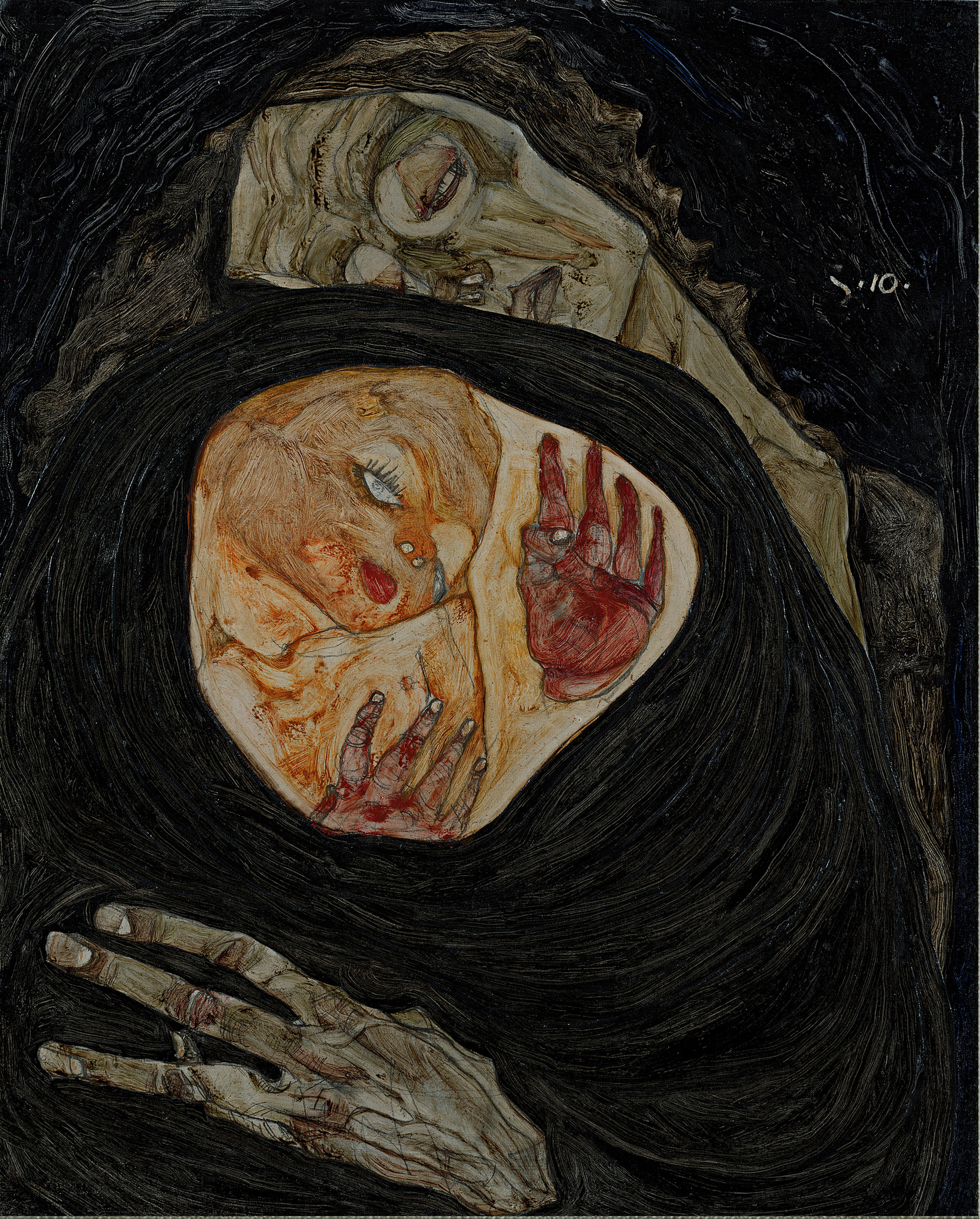
Dead Mother I is a work of 1910 by Egon Schiele: at the top the pale, sunken face of a dying mother, in the centre a glowing orange oval with a child’s head and small red hands, all of it wrapped in a mass of circling black strokes. The original is in the Leopold Museum in Vienna under inventory number 475; it measures 25.7 x 32.1 cm — 25.7 cm wide and 32.1 cm tall, a small upright panel. We make it as a hand-painted oil painting on canvas, in thirteen sizes or to your own measurement, and we send you a photograph of the finished work for approval before it ships.
| Title: | Dead Mother I |
| Other titles: | Tote Mutter I · Mrtva mati I |
| Painter: | Egon Schiele (1890–1918) |
| Year: | 1910; monogrammed and dated upper right “S. 10.” |
| Original size (width × height): | 25.7 cm x 32.1 cm |
| Original technique: | Oil and pencil on wood |
| Style: | Expressionism |
| Location: | Leopold Museum, Vienna (inv. 475) |
| Our reproduction: | hand-painted oil on canvas, 13 sizes from 50 x 65 cm to 160 x 205 cm, or a made-to-measure size |
Dead Mother I – Egon Schiele
What does the work show?
Two heads and three hands on a black ground. At the top, tilted, is the mother’s face, pale greyish yellow with sunken features and a half-closed eye, framed by dark brown hair; along the right edge her pale shoulder runs down. Almost the whole rest of the panel is black, laid on in thick circling strokes that sweep round like a wrapping. In the middle of that black sits a warm orange oval, and in it the child: a head turned on its side, with a red mouth and one visible eye, and two small red hands, one of them raised with the fingers apart. At the lower left, over the black, lies a large, bony, pale hand — the mother’s. Upper right, small and white, are the monogram and date.
Who is the child?
Per the museum record, the unborn child. A cocoon of broad brushstrokes encloses it; its head, seen from below, and its left hand, raised in what looks like a gesture of blessing, form the brightly glowing centre of the composition. The mother, in cool dark shades with sunken features and breaking eyes, seems to be saying goodbye, and the supposedly protective gesture of her emaciated hand adds to the impression of dying. That is the reading of the museum that holds the work, and we give it as theirs.
Does the mother’s death doom the child or free it?
The museum leaves both open. It asks whether her demise will seal the fate of the unborn child or whether its bonds will be broken by her death, and says that the painting allows for both interpretations. It also reads the work as a remarkable juxtaposition of sexuality and death, carried by the mother-and-child theme. We do not choose between the readings either.
How quickly was it painted?
According to Arthur Roessler (1877–1955), whom the museum cites, Schiele painted it on Christmas Day 1910 within only a few hours. He was twenty. A few months later, per the record, he himself counted this first version of Dead Mother among his best works.
What is the original painted on?
On wood. Per the record the technique is oil and pencil on a wooden panel, and the monogram and year “S. 10.” stand upper right. Our reproduction is painted in oils on canvas. We do not present those as the same thing: a small panel in oil and pencil and a stretched canvas are different supports, and we name the difference.
Is the format upright or horizontal?
Upright. Our steps follow it in a portrait format, from 50 x 65 cm to 160 x 205 cm. The height gives the black room to wrap round the oval from top to bottom.
Can I have it at the size of the original?
At the size of the original, no: the panel is 25.7 x 32.1 cm, and our smallest step, 50 x 65 cm, is about twice as wide and twice as tall. In proportion it depends on the step. The original’s ratio of sides is 1 : 1.249, and four steps come within two millimetres of it in height: 60 x 75 cm, 80 x 100 cm, 120 x 150 cm and 65 x 81 cm. The other nine are cut taller, by about 2.5 cm or about 5 cm; 50 x 65 cm, 100 x 130 cm, 140 x 180 cm and 160 x 205 cm are the furthest. If the exact proportion matters, choose one of the four or a made-to-measure size.
Where does the work come from and where is it now?
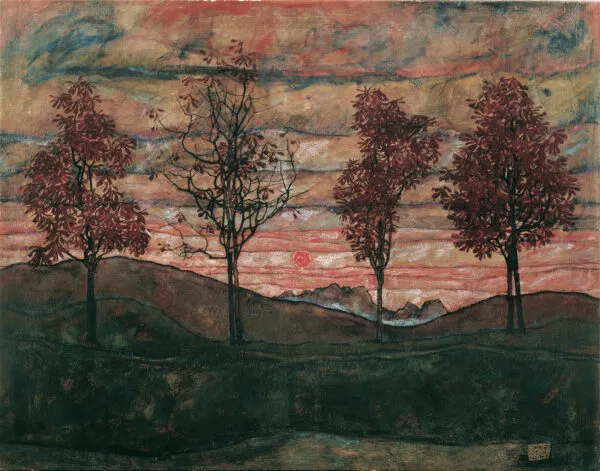
This page carried no provenance note before — for this work there was none, which we say openly rather than quietly supplying a substitute. What follows is the chain as the museum publishes it, and it is short: Arthur Roessler, Vienna, from before 1913 to 1951; Rudolf Leopold, Vienna, from 1951 to 1994; and from 1994 the Leopold Museum Private Foundation. The reading of it is ours. The first owner bears the name of the source the museum quotes for the painting’s making, Arthur Roessler, and the record gives no start date for him, only “before 1913”. For Leopold it cites a dossier by Sonja Niederacher of 30 April 2011 and Diethard Leopold’s book on Rudolf Leopold published in 2018. Roessler’s name also opens the chain of Setting Sun in the same collection. The work is today in the Leopold Museum under inventory number 475; the museum’s whole Schiele holding is on the Leopold Museum’s Egon Schiele page.
Where does this work sit among Schiele’s works?
At the start of a theme he kept returning to. The museum names the later works that carry the mother-and-child subject on, among them Mother and Child of 1912; from the same year as that painting, and likewise a small panel, is the Self-Portrait with Lowered Head. The full selection is in the Egon Schiele gallery, with more on his life in our article about Egon Schiele. Schiele was a younger contemporary of Gustav Klimt and the Vienna Secession was the milieu he came out of; Viennese Expressionism is the movement he helped define, and Austrian art of the period is still read through those two names. As an expressionist painting it holds life and death in one small panel. Setting Sun is oil on canvas; this panel is not.
How is our hand-painted version made?
Every canvas is painted by an artist in oils, stroke by stroke — not a machine impression but a hand-painted copy made for your order. Two places are the hardest here. The first is the black: it is not a flat background but thick strokes that circle round the oval, and their direction is what makes the wrapping; paint it as a smooth black and the cocoon disappears. The second is the contrast between the two faces — the child’s warm, glowing orange and the mother’s cool, greyish pallor must stay far apart; warm the mother or cool the child, and the painting loses the difference between the living and the dying. When the work is finished we photograph it and send you the photograph for approval, and only then does it ship. For this family we hold no studio photographs — it has not been photographed in our workshop yet, and nothing has been removed; when it is next painted it will be photographed and the images added here. As a canvas reproduction it arrives stretched on a wooden bar, ready to hang.
Which size suits which wall?
Short answer: this is an intimate subject, and it does not need to be large. For a narrow wall, a hallway or beside a doorway 50 x 65 cm or 60 x 75 cm; above a sideboard 80 x 100 cm; for a large room 120 x 150 cm and up to 160 x 205 cm. Our smallest size is 50 x 65 cm, already about twice the original. A canvas painting of this subject changes with scale: at the smaller steps it keeps the closeness of the panel, at the larger ones the circling black becomes the first thing you see.
How do I order a made-to-measure size, stretcher bar and frame?
If none of the thirteen sizes suits your wall, we paint the work to your own measurement. The canvas comes stretched on a wooden bar; our 3D application is for choosing a frame only, not for showing the work on your wall. The frame is chosen separately and need not be part of the order.
How is it delivered and what do we guarantee?
We paint to order and deliver to sixteen countries in the European Union, among them Germany, France, Italy, the Netherlands and Poland; the United Kingdom and Ireland are not currently among them. Before dispatch we send you a photograph of the finished work for approval, and if you are not satisfied we correct the work or paint it again. Production time varies with the size and the studio’s workload.
Frequently asked questions
What does Schiele’s Dead Mother I show?
A dying mother and, according to the Leopold Museum, her unborn child: the child’s glowing head and small raised hand sit in a cocoon of broad black brushstrokes, while the mother’s face above is pale and sunken. The museum reads the work as a remarkable juxtaposition of sexuality and death, and leaves open whether the mother’s death seals the child’s fate or frees it.
Why is it called Dead Mother I?
Because it is the first version: a year later, in 1911, Schiele painted Dead Mother II, which is also known as The Birth of Genius. The mother-and-child subject stayed with him, and the Leopold Museum names later works that carry it on, among them Mother and Child of 1912.
When was Dead Mother I painted?
In 1910; the panel is monogrammed and dated upper right “S. 10.”. According to Arthur Roessler, whom the museum cites, Schiele painted it on Christmas Day 1910 within only a few hours. He was twenty at the time.
Who was Arthur Roessler?
A Viennese art critic who, writing in the Arbeiter-Zeitung, was the first to recognise and defend Schiele, and who became a close friend, bought his works and introduced him to collectors. Schiele painted his portrait in 1910. Roessler was also the first owner of Dead Mother I, from before 1913 to 1951, and in 1911 Schiele wrote to him that it was one of his best works.
Where is Dead Mother I today?
In the Leopold Museum in Vienna, under inventory number 475. The museum lists Arthur Roessler (before 1913 to 1951) and Rudolf Leopold (1951 to 1994) as earlier owners; since 1994 it has belonged to the Leopold Museum Private Foundation. It is a small upright panel, 25.7 x 32.1 cm, in oil and pencil on wood.
Does it work as a gift?
It does; if you are unsure which size to choose there is a gift voucher.
- Subject: a dying mother above, an unborn child in a glowing oval, wrapped in circling black.
- Original: 1910, oil and pencil on wood, 25.7 x 32.1 cm, monogrammed upper right, Leopold Museum, Vienna, inv. 475.
- Ours: hand-painted in oils on canvas, 13 sizes or a made-to-measure size.
- Worth knowing: per Arthur Roessler, Schiele painted it within a few hours on Christmas Day 1910.